
The Best Gospel He Could Preach
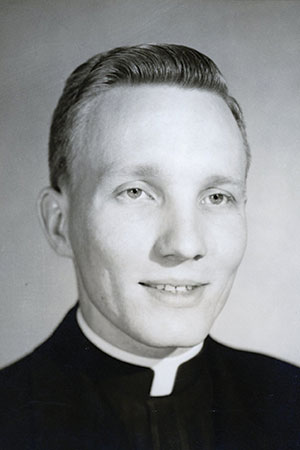 Remembering Father Stephen L. Schroeppel, M.M. (1931–2008)
“For the Africans, just living among them was the important gift, not what we accomplished. We had left families, friends, our customs, and way of life to live our lives with them. The thought gradually emerged that this is the best Gospel I could preach.”
—Father Stephen Schroeppel, M.M.
A Son Named for a Priest’s Prayer
Stephen Lawrence Schroeppel arrived in the world on October 21, 1931, in Jamaica, New York, the long-awaited third son of Charles and Carolyn Schroeppel. He was 11 years younger than his nearest brother, George, and 12 younger than his eldest, Charles, Jr. His mother had been told, gently and firmly, that there should be no more children. The decade of pain she carried after George’s birth had been searching for an end.
In those years she prayed often with her parish priest and confessor, Father Lawrence Stephens. When she became pregnant a third time, his prayers walked beside hers. One month before the child’s birth, Father Stephens died. When the baby came, the pain ended in a single, complete moment and never returned. Charles and Carolyn named their third son in his honor, reversing the priest’s name into a small act of thanksgiving: Stephen Lawrence.
It is the kind of story Maryknollers know well. Every vocation begins with someone praying for it.
The Field Afar
By the time Steve was leafing through the pages of The Field Afar, the magazine that, in those years, carried the world into Catholic homes, the path was already opening. He met his first Maryknoller, Father Walter Maxcy, the one who, as he later put it, “made the difference.” He read When the Sorghum Was High, the account of the murder of Father Gerry Donovan in Manchuria. He spoke with the cousins of Maryknoll co-founder Father James Anthony Walsh. He attended Our Lady of Mercy School in Port Chester and Blessed Sacrament High School in New Rochelle. And on June 27, 1949, at the age of 17, he entered Maryknoll.
“We are happy and proud about what you are doing,” his parents told him during those seminary years, “and while we encourage you, know that we will be equally supportive if you find out that being a missionary priest is not for you.” Carolyn was extremely proud. So was Charles, Sr. The freedom they offered their son was itself a gift; he never needed to use it.
On June 14, 1958, in the Queen of Apostles Chapel at Maryknoll, New York, Cardinal Francis Spellman laid hands on Stephen Lawrence Schroeppel and the men of his ordination class. Eight days later, on June 22, he offered his First Solemn Mass at the Church of the Resurrection in Rye, New York. Within the same month, he received his assignment: Tanganyika.
20 Years in East Africa
From 1958 to 1978, through Tanganyika’s independence and its merger into Tanzania, Father Steve walked with the people of East Africa. He drove a Volkswagen beetle from village to village. He sat on rocky outcrops above the Serengeti to pray and read, watching for baboons that could turn aggressive. When asked what he thought was the most dangerous animal of the savanna, he gently corrected the lions out of the answer and named the Cape buffalo instead. Once, faced with a swollen river and no other crossing, he simply drove the beetle into it; the water rose past the windshield and over the roof and let him out the other side. “Only a young person would try this,” he said later, with the laugh that everyone who met him remembered.
For nearly two decades he spoke Swahili almost exclusively. He dreamed in Swahili. When he returned to the United States in 1978, he sometimes had to reach for the English word for an ordinary thing and find it in Swahili first. He had been so completely received into the life of his African parishes that whenever he visited a village, families competed for the honor of hosting him in their home. “It made him feel very loved,” his nephew Bob remembers.
And in the slides he carried home and showed to fourth graders in Missouri, what they remembered most was not the lions but the smiling family groups, the daily routines, the children. He worried openly about the lack of clean drinking water. He wanted American children to understand how their brothers and sisters lived. A nine-year-old in Malden, Missouri, was flying high for days after the visit, and 60 years later that nine-year-old still carries the slides in his memory.
A Priest in the Ordinary Things
Father Steve had an infectious laugh and an easy-going manner. He never met a stranger. He smoked a pipe, and his great-nieces who had never been around anyone who smoked one can still summon the aroma of it when they think of him. He was, by every account, all about family.
One Friday night in the years before the Council loosened the rule, his nephew Bob came back from a high school football game concession stand happily eating a hot dog. Father Steve looked at him with a sly grin. Bob realized at once and began to apologize. “God would think it was a bigger sin if you threw it away and wasted a perfectly good hot dog,” Father Steve said. “Eat up.” That was how he carried his priesthood in the ordinary things.
One Thanksgiving, his great-niece Ann brought a handful of small rosaries she had made by hand and asked her great-uncle to bless them. She expected a quick sign of the cross. He sat her down and walked her through the rosary instead, slowly, lovingly, beginning to end. She is in her 40s now, and that afternoon is still with her.
Returning, but Never Quite Leaving
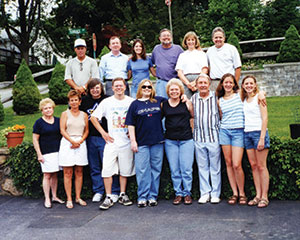 In 1978 Father Steve returned to the United States for mission education and promotion work to Metairie, Houston, Philadelphia, Cleveland, Detroit, and finally St. Louis, where he stayed the longest. He missed Africa for the rest of his life and hoped quietly that Maryknoll might one day send him back. But he poured himself into the work of the present. He loved visiting parishes and grade schools. The honesty of children delighted him. On Mission Sundays in his nephew’s home diocese in southern Missouri, parishioners came away from his talks struck by his sincerity and the ease with which he greeted them.
On Father’s Day, June 1979, in St. Ann’s Catholic Church in Malden, Missouri, Father Steve stood at the font and baptized his great-niece Allison Frazier Schroeppel and her cousin Stephen Charles Schroeppel II in a double baptism. Allison wore the christening gown her great-grandmother Carolyn had sewn for her grandfather George in 1920. Twenty-five years later, in 2004, Father Steve presided again, this time at Allison’s wedding to Michael Christian Duncan.
For roughly 15 years, the five Schroeppel siblings of Missouri brought their families to the Maryknoll house in St. Louis every Thanksgiving to share the table with their uncle. In 2005, when the tradition finally ended, he wrote them a letter, addressed with characteristic warmth to his “Niece, Nephews, and the Grand…s, my Mizzou-ra (rah) Kin”: “A wise person stated that there is no such thing as coincidence,” he wrote, “that somehow God ties up the loose ends for us. Yes. And today is no exception. I am very grateful for these years with you.”
“God Wasn’t Ready for Me Yet”
In 1998 four of the five Schroeppel siblings traveled to New York for Father Steve’s 40th-anniversary celebration. He took them to Maryknoll in Ossining and showed them the grounds. A few days later, on a tour of the New York neighborhoods where he and George had grown up, he suffered a heart attack on a subway platform. New Yorkers and the police moved with grace and speed. He recovered. Later he told Bob that, as he lay there with his nephews kneeling over him, he had felt himself begin to rise into the air—that he could see their backs from above, that he had felt a hand on his back press him gently down again. “God wasn’t ready for me yet,” he said. “He must have something else in mind for me.”
He had ten more years. He spent them as he had spent all the others: visiting parishes, telling stories, blessing rosaries, baptizing babies, presiding at family weddings, smoking his pipe, and asking after every relative by name.
On June 6, 2008, just after a long phone call with a dear friend in New York, Father Stephen Lawrence Schroeppel, M.M., suffered a final heart attack at the Maryknoll house in St. Louis. He was 76 years old. Eight days later, on what would have been the 50th anniversary of his ordination, his Maryknoll family gathered in the Queen of Apostles Chapel, the same chapel where Cardinal Spellman had ordained him, for his Funeral Mass. He was buried in the Maryknoll Cemetery, near the men he had begun and ended his priesthood beside.
The Gift Itself
Bob Schroeppel, who is 71 and lives in Springfield, Missouri, with his wife Kerry, still researches the Schroeppel family genealogy his uncle so loved. His daughters Allison and Ann, and his grandchildren Grace and Jack, all grew up inside his stories of Father Steve. Maryknoll has been part of Bob’s consciousness, in his words, for as long as he can remember. He continues to carry the missioners in his prayers.
And he continues to remember the line his uncle once said about the meaning of his 20 African years, a line that, taken slowly, is the whole of Maryknoll in three sentences:
“For the Africans, just living among them was the important gift, not what we accomplished. We had left families, friends, our customs, and way of life to live our lives with them. The thought gradually emerged that this is the best Gospel I could preach.”
It is the Gospel Father Steve preached for 50 years, in Tanganyika and in Tanzania, in Metairie and Houston and Philadelphia and Cleveland and Detroit and St. Louis, on subway platforms and at football games, in the chapel and at the Thanksgiving table, in front of fourth graders and in front of brides. It is the Gospel his family received from him; it is the Gospel his family now offers, through one nephew’s carefully written letter, back to the Maryknoll he loved.
May his memory be a blessing. May the missioners he prayed for receive the same quiet, faithful love he received from Charles and Carolyn, from George and Charles, Jr., from Bob and Kerry, and from Allison and Ann.
And may we all, in the small parishes and ordinary days of our own lives, learn to live among one another as the gift itself.
© Pentera, Inc. Planned giving content. All rights reserved.
Disclaimer